 In a dramatic early morning raid June 4, some 400 NYPD cops wearing bullet-proof vests stormed the Manhattanville and Grant housing projects in Harlem, arresting scores in what was boasted as the largest gang case in New York City history. In what was dubbed Operation Crew Cut Initiative, police commissioner William Bratton announced 103 indictments of accused members of the Make It Happen Boys, Money Avenue and 3 Staccs gangs. Charges in the 145-count indictment include conspiracy to commit murder, conspiracy to commit gang assault, and weapons possession. Of those indicted, 41 were already in jail on other charges. The three warring crews are held responsible for at least two homicides and 19 shootings in and around the housing projects in recent years. The suspects are all between 15 and 30 years old. "If you choose this lifestyle, you will suffer the same fate as these individuals," Bratton said at a news conference later in the day. (Daily News, WABC, Newsday, June 4)

 Dean Becker, a former reporter at non-commercial KPFT in Houston, has produced a worthwhile if deceptively named book in To End the War on Drugs: A Guide for Politicians, the Press and Public. Rather than the activist how-to manual promised in the subtitle, it is a series of interviews with leading lights in the drug policy reform movement. And rather than explaining how, they are mostly making the case as to why the "drug war" must end.
 The US Supreme Court issued a key ruling in favor of Fourth Amendment rights in the digital age June 25, finding unanimously that police in most cases need a warrant before searching the cellphone or personal electronic device of an arrestee. Chief Justice John Roberts firmly rejected arguments that searches of digital devices are comparable to searches police routinely carry out for contraband after making an arrest. In the cases of
 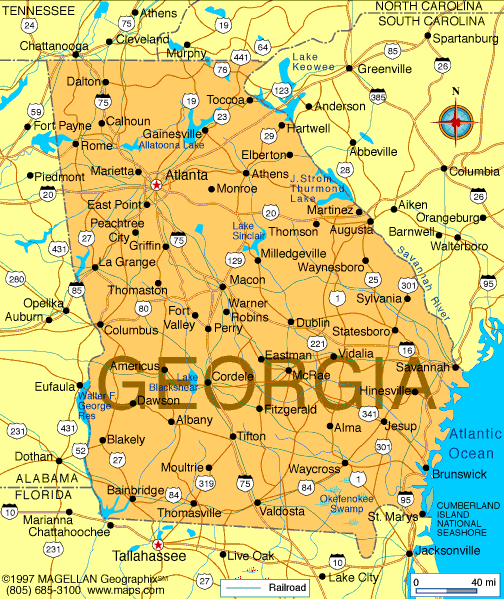 A Georgia family and state lawmakers are demanding a federal investigation into the case of a toddler severely injured by a flash grenade during a drug raid May 28. Bounkham Phonesavanh—19 months old, and nicknamed Bou Bou—remains in a medically induced coma at the Grady Memorial Hospital burn unit in Atlanta. Habersham County District Attorney Brian Rickman told AP his office is investigating to determine whether any officers will face criminal charges. Police said officers were searching for a potentially armed drug suspect at the home and did not know children were inside when they broke down the door and threw in a flash grenade. The grenade landed in the sleeping boy's playpen, according to both authorities and the Phonesavanh family.
 The US Supreme Court ruled 5-4 on April 22 in Navarette v. California that a traffic stop that led to a marijuana arrest was constitutional because police had reasonable suspicion the driver was intoxicated. In 2008, California Highway Patrol officers stopped Lorenzo Prado Navarette's pickup truck on a Mendocino County road based on a 911 tip about reckless driving. The officers said they smelled marijuana when approaching the vehicle. They conducted a search and found 30 pounds of cannabis. Navarette and a passenger were arrested and charged. At trial, they moved to suppress the evidence on grounds that the search violated their Fourth Amendment rights because the officers lacked reasonable suspicion when they pulled Navarette over. But in the opinion authored by conservative Justice Clarence Thomas, the majority found that while an anonymous tip will not always lead to reasonable suspicion, in this case it did. The court found that "under appropriate circumstances, an anonymous tip can demonstrate sufficient indicia of reliability to provide reasonable suspicion to make an investigatory stop." Conservative Justice Antonin Scalia wrote a dissent that was joined by the court's liberals, Ruth Bader Ginsburg, Sonia Sotomayor and Elena Kagan. Conservatives John Roberts and Samuel Alito lined up with the majority, as did swing voters Stephen Breyer and Anthony Kennedy. (



Recent comments
10 weeks 6 days ago
11 weeks 2 days ago
19 weeks 3 days ago
20 weeks 4 days ago
21 weeks 2 days ago
26 weeks 4 days ago
33 weeks 1 hour ago
33 weeks 8 hours ago
36 weeks 1 day ago
37 weeks 8 hours ago