
 In another sign of the new progressive tilt in New York City politics, the New York Post reports July 8 that Brooklyn District Attorney Ken Thompson has announced that he will stop prosecuting low-level marijuana cases. Thompson's press release said his new policy is to "prevent offenders—who are disproportionately young men of color—from being saddled with a criminal record for a minor, non-violent offense." But Police Commissioner Bill Bratton said his cops will keep arresting Brooklyn's cannabis tokers anyway. "In order to be effective, our police officers must enforce the laws of the State of New York uniformly throughout all five boroughs of the City," Bratton said in his own statement. "Accordingly, the Kings County policy change will not result in any changes in the policies and procedures of the NYPD."
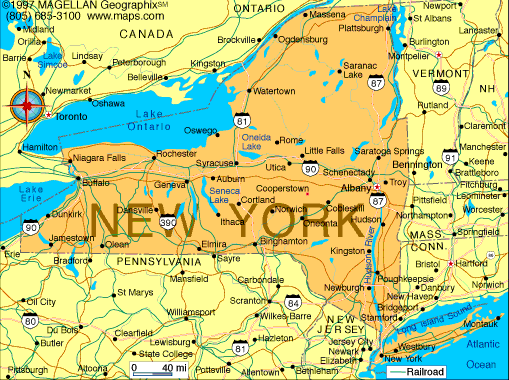 Gov. Andrew Cuomo signed a bill into law July 7 that makes New York the 23rd medical marijuana state. Advocates celebrated a deal struck last month between Cuomo and the state legislature that will protect qualified patients from arrest, prosecution and discrimination, and license up to 20 distribution facilities across the state. The new law empowers the New York State Department of Health (
 On June 27, Massachusetts' Department of Public Health
  The US Supreme Court issued a key ruling in favor of Fourth Amendment rights in the digital age June 25, finding unanimously that police in most cases need a warrant before searching the cellphone or personal electronic device of an arrestee. Chief Justice John Roberts firmly rejected arguments that searches of digital devices are comparable to searches police routinely carry out for contraband after making an arrest. In the cases of
  US authorities report a record flood of unaccompanied minors crossing the southern border, a wave that has been escalating since 2011. About 52,000 have arrived since October, about 112% more than the entire prior year, Alejandro Mayorkas, deputy secretary of the
  A Georgia family and state lawmakers are demanding a federal investigation into the case of a toddler severely injured by a flash grenade during a drug raid May 28. Bounkham Phonesavanh—19 months old, and nicknamed Bou Bou—remains in a medically induced coma at the Grady Memorial Hospital burn unit in Atlanta. Habersham County District Attorney Brian Rickman told AP his office is investigating to determine whether any officers will face criminal charges. Police said officers were searching for a potentially armed drug suspect at the home and did not know children were inside when they broke down the door and threw in a flash grenade. The grenade landed in the sleeping boy's playpen, according to both authorities and the Phonesavanh family.



Recent comments
15 weeks 19 hours ago
15 weeks 3 days ago
23 weeks 4 days ago
24 weeks 5 days ago
25 weeks 4 days ago
30 weeks 6 days ago
37 weeks 1 day ago
37 weeks 1 day ago
40 weeks 2 days ago
41 weeks 1 day ago