
 Spain's Guardia Civil on July 1 announced the seizure nearly 16 tons of hashish from a vessel intercepted 45 nautical miles south of Malaga. The crew of nine were all arrested—six Syrian and three Indian nationals. The 85-meter vessel, the Just Reema, was sailing towards the eastern Mediterranean under a Congolese flag when it was boarded by the Guardia in a joint operation with French and Italian police forces dubbed "Urca," coordinated through Europol. When the vessel was first searched at sea, police found only a cargo of about 1,500 tons of salt. However, once it was brought into port at Malaga for a more thorough inspection, agents discovered that the craft had a double bottom that hid 15.7 tons of hashish. Europol estimates the value of the haul at about 24 million euros ($ 26.5 million), if sold on the Spanish market. According to the Organized Crime and Corruption Reporting Project (OCCRP), over the past two and a half years European police forces in the Mediterranean have seized 22 ships carrying up to 30 tons of hashish each.
 A June 21 article in Sri Lanka's
  Delaware's Gov.
  The
The  Israel has been a
  In a unanimous decision, a seven-justice bench of the
  After an electoral season marred by narco-violence and assassination of candidates of all parties, the results from Mexico's June 7 vote are in. The coalition led by the Institutional Revolutionary Party (
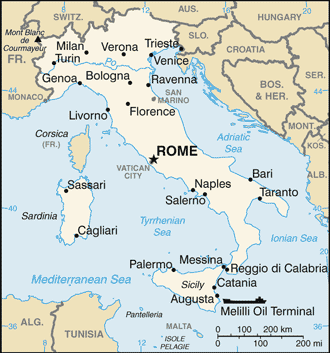 Italian police staged a joint operation in the Mediterranean with Turkish, French, Egyptian, Spanish, Moroccan and



Recent comments
15 weeks 1 day ago
15 weeks 4 days ago
23 weeks 5 days ago
24 weeks 6 days ago
25 weeks 5 days ago
31 weeks 4 hours ago
37 weeks 2 days ago
37 weeks 3 days ago
40 weeks 3 days ago
41 weeks 3 days ago