
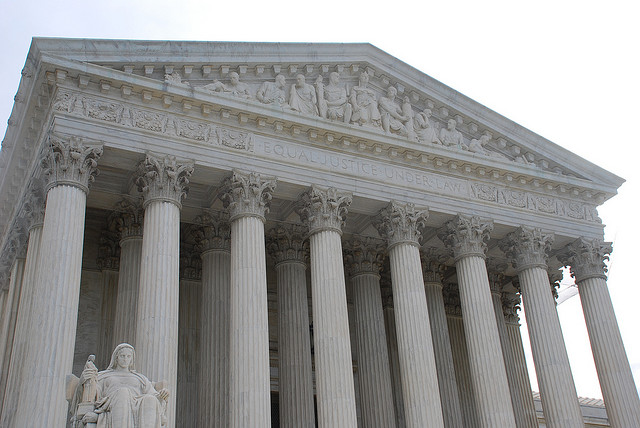
 The US Supreme Court on June 23 ruled that Damon Landor, a Rastafarian man imprisoned in Louisiana, could not sue the Louisiana Department of Corrections (LDOC) officials who restrained him and cut off his dreadlocks. Justice Neil Gorsuch delivered the 6-3 opinion, which focused on the applicability of the Religious Land Use & Institutionalized Persons Act of 2000 (RLUIPA) to state employees.
The Court reasoned that the sanctions imposed by RLUIPA only apply to "those who have knowingly and voluntarily agreed to them." Using a contract analogy, the majority held that while LDOC could be sued under RLUIPA, the individual LDOC employees never agreed to answer suits and therefore Landor could not proceed against them.
The dissenting opinion, written by Justice Ketanji Brown Jackson, called the majority's contract analogy an "effortless conflation of law making and agreement making—two different sources of binding authority." Justice Jackson argued that the majority's notion of consent is a "dramatic innovation."
RLUIPA was enacted in 2000 under the Clinton administration to forbid "State and local governments from imposing a substantial burden on the exercise of religion." It derives authority from the Spending Clause of the Constitution, which gives Congress the power to provide for the "general Welfare" of the United States by conditioning the distribution of funds to states on compliance with federal laws. RLUIPA is one such law. Congress gives money to LDOC provided that it adheres to RLUIPA, which states that plaintiffs may seek "appropriate relief against a government," with "government" including any governmental entities created under the authority of a state, officials of those entities, and "any other person acting under color of State law."
This statutory language anchors the arguments of the dissent, as well as several religious organizations that filed amicus briefs—including the Christian Legal Society, the Jewish Coalition for Religious Liberty and the Tayba Foundation—and Landor himself. The latter is a devout Rastafarian who follows the biblical Nazarite Vow, an oath described in the Book of Numbers that commands a follower to "let the locks of the hair of his head grow long." He had adhered to this oath for decades before being incarcerated on cocaine and amphetamine charges in 2020, and then transferred to the Raymond Laborde Correctional Center, with just three weeks left of his sentence. Fearing that authorities at the Raymond Laborde center would attempt to make him to break his vow, Landor took with him a copy of a 2017 Fifth Circuit RLUIPA decision that affirmed a religious right of inmates to wear dreadlocks, Ware v. LDOC. The prison officials threw it in the trash and handcuffed him to a chair before shaving his head.
The ruling against Landor diverges from a recent run of Supreme Court decisions favoring religious freedom claims. In a 2020 case, the Court permitted Muslim men to sue the FBI for unreasonably placing their names on a "No Fly List." In a June 2025 case, the Supreme Court permitted parents to opt out of LGBTQ-inclusive curriculum on the basis of religion. In an April 2026 case, the Court ruled that faith-based ministries could seek federal protection from threatening investigations by state officials.
While Landor did not see the favorable outcome won by the plaintiffs in these previous cases, he stated that he is "disappointed but not defeated," and plans to "continue pursuing accountability."
Photo by Delta Mike




Recent comments
1 day 3 hours ago
16 weeks 3 days ago
16 weeks 6 days ago
25 weeks 3 hours ago
26 weeks 1 day ago
26 weeks 6 days ago
32 weeks 1 day ago
38 weeks 4 days ago
38 weeks 4 days ago
41 weeks 5 days ago